AI receptionist for small business
An AI receptionist for small business is a phone answerer that uses a brief you wrote. It says it is an AI, gives the facts you put in that brief, transfers to your own people when a rule says so, and takes a message the rest of the time. You get a summary of who called and what they needed. It fits a shop where the same questions arrive while the counter is empty or while you are on a delivery. It does not fit a call that needs a person to decide, to comfort someone, or to give advice you have not written down.
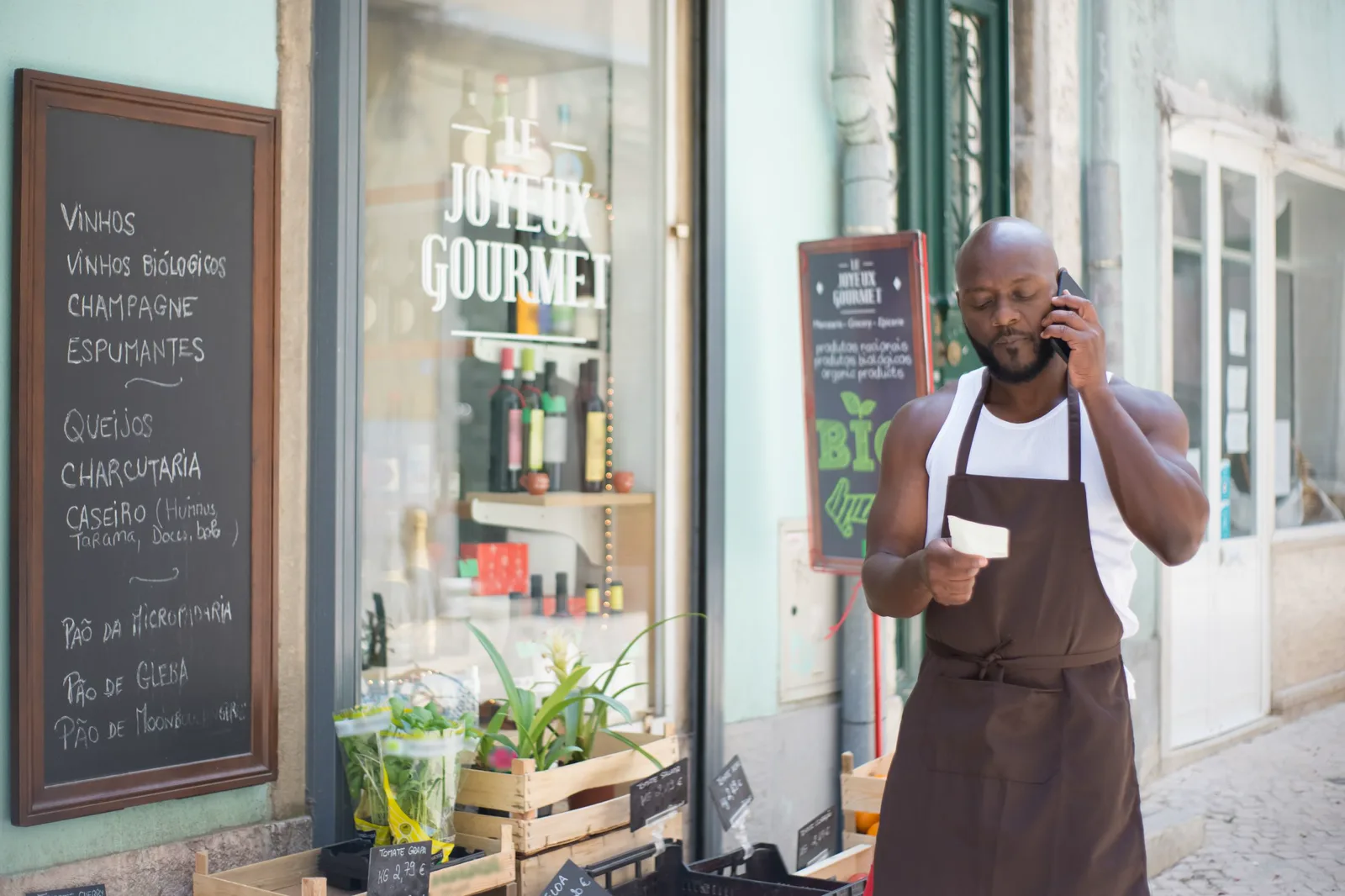
The example on this page is a two-person food shop. Call it Harbor Pantry. It is not a real customer and not the shop in the photo. The shape is the same for a one-truck trade: a short list of facts, one or two transfer rules, and a message for everything else. If you are the only person, the solo version of this choice is phone answering for a one-person business. This page is the shop that sometimes has two people and often has one.
One Saturday call
The shop is open 9 to 5, Tuesday through Saturday. Sunday and Monday are closed. That is in the brief, including the holidays you have already decided.
A caller asks if you are open Sunday. The receptionist says the hours that are written. It does not add "but we might open for you." The caller then asks if the cheddar on the card is in stock. If the brief says you do not promise stock by phone, the receptionist says that, and offers to take a name and a number so someone can check the case. If the brief lists a price you are willing to say, it says that price and stops. It does not invent a second price for a larger piece.
The caller then asks for a tray for a party of twenty, delivered, on a date. That is not a fact on the card. The rule says catering questions transfer to the owner's cell during open hours, and become a message when the shop is closed or the cell does not answer. The message needs the date, the headcount, the neighborhood, and a callback number. It does not say the tray is reserved. You read the summary and you decide.
That is the whole product on a real call. Hours from the brief. A limit you wrote, instead of a guess. A transfer only where you named one. A message you can act on.
Who it fits
It fits when the phone rings in the hour you are least able to hold it. One of you is on a delivery. The other is with a customer at the counter and cannot talk about a party tray in front of the line. The shop is closed, and the caller only needed Sunday's answer. Answering calls while working is that hour for a trade. A shop has the same hour, just standing still.
It also fits the question you are tired of repeating, if you are willing to write the answer once and stand behind it. "We close at 5." "We do not deliver past the river." "A loaf is the price on the card." Those lines belong in the brief. They do not belong in a voicemail you listen to at 9 pm.
A month with few calls is a normal month for a small shop. The number is still $1.99. You are not paying a seat for a person who sat idle. You pay $0.20 a minute for the minutes the receptionist was actually talking, after the first 10 seconds of each call, in 6-second steps. A 2:10 call bills as 2:00.
Who should keep a person
Keep answering yourself, or pay a staffed service, when the call is the business. A regular who is angry about a bad round of cheese wants a person who can replace it or refund it. The receptionist can take the name and the problem. It should not apologize with a promise you did not write, and it should not argue.
Keep a person when the answer is advice. What to serve with a wine. Whether a dish is safe for a guest. Whether a contract term is fair. None of that belongs in a brief you dashed off, and a wrong sentence is worse than a callback.
Keep a person if the counter is already staffed every open hour and someone there can reach the phone. An AI line on top of a person who picks up is a second greeting nobody asked for. Use the AI line for the closed hours and for the overflow, not as a replacement for a desk that is working.
The U.S. Small Business Administration's manage your business page, opened 16 November 2026, lists one customer-service idea as automating the phone so calls route to the right department. A two-person shop often has no departments. Do not invent them to match the sentence. The practical route is one or two rules. A catering question goes to the owner's cell during open hours. A "what time do you close" question is answered from the brief. Everything else is a message. That is the routing. It is not a phone tree of departments you do not have.
A brief you can keep true
Write only what you will still mean next month. For Harbor Pantry that is a short list.
- Hours, including the two closed days, and what "closed" means for messages.
- The neighborhoods you deliver to, and the ones you do not.
- Prices you will say on the phone. If the price changes weekly, do not put it in the brief. Say the card in the shop is the price, and offer a callback.
- What you never promise: stock you have not checked, a tray you have not confirmed, a time you have not agreed to.
- Who gets a transfer, on which kind of call, during which hours.
Read it the way a new Saturday hire would. A vague line ("we're flexible on delivery") becomes a vague answer. A specific line ("we deliver within two miles of the shop, and we confirm the day before") can be said out loud. When the hours change for a holiday, change the brief before the holiday, not after a caller is told the old version.
The receptionist does not know the walk-in who is standing at the counter. It does not see the case. If the brief says "we do not confirm stock by phone," that is the correct answer even when you can see three wheels of cheddar from where you are standing. You can still call the person back. The phone should not guess.
Transfer rules a shop of two can keep
Name the phones. The owner's cell. The other person's cell, if they agreed to take a kind of call. Not "whoever is free," because the receptionist cannot see the shop floor.
A transfer that rings the shop's own published number will loop, or it will hit the forward and start the greeting again. The cell has to be a different number, one a person answers. Call it once, from outside, before you put it in the rule.
If nobody answers, the caller gets a message, not a hold that never ends. Say that in the brief so the receptionist does not imply someone is walking over. "If we cannot reach the owner, we take a message and call you back." Then do call back. The rule is a promise only if you keep the pile of messages the same day.
Urgent can be one sentence. For this shop it might be a delivery that is already out and a customer who says the address is wrong. That transfers. A question about Sunday does not, even if the caller says it is urgent. If everything is urgent, the cell rings all day and you stop trusting it.
The number on the window stays put
The number painted on the glass, or printed on the card, stays with the carrier that has it now. RingKit does not port numbers. You forward that number to the RingKit number, for the hours you choose. Closed all day is one setting. No answer after four rings, during open hours, is another. The second one lets the person at the counter pick up when they can, and sends the rest onward.
Test from a friend's phone. Call during open hours and pick up. Call and let it ring. Call on Sunday. If Sunday still reaches the counter phone's mailbox, the mailbox is winning and the receptionist never heard the question. Fix the carrier setting before you judge the brief.
A payment method is required before the RingKit number goes live. You top up a wallet. The smallest top-up is $10. Calls and the $1.99 number fee come out of that wallet. There is no monthly plan, no seats, and no contract. A month you forget to forward is still $1.99 if the number is active. Release it if you stop.
Forty minutes of talk in a month is 40 times $0.20, which is $8, plus $1.99 for the number. That is arithmetic from the rates, not a prediction of your bill. Your carrier may also charge for the forward. The pricing page is where those RingKit figures live if they change.
A week at the shop
Monday the shop is closed. Two people call. One asks the hours and hangs up satisfied. The summary says so, and you do nothing. One asks about a tray for Saturday. The summary has the date, the headcount, and a number. You call Tuesday morning, before you start the case. You do not discover the tray request at noon on Saturday.
Wednesday both of you are in. The counter is busy from 11 to 1. Four calls arrive. Two are hours and delivery area, answered from the brief. One is a regular asking for the owner by name. The rule transfers that one to the cell, and you step off the floor or you let it become a message if you cannot. One is a wrong number for a different business. The summary says so. You do not call them back.
Friday a caller wants a price you refused to put in the brief because it changes. The note says they asked, and that the receptionist declined to guess. You call if you want the order. The refusal was the point.
Sunday is closed again. A caller asks for Sunday hours, hears them, and asks to leave a name for a Monday callback. That is a message, not a transfer to a cell you turned off for a reason. If you listed the cell as an all-day transfer, Sunday will find you. Do not write that rule and then resent it.
None of these counts are a benchmark. They are one imagined week so the piles are visible. Your week will be thinner or louder. Read your own summaries. Do not adopt someone else's volume.
What you still do yourself
You still confirm the tray. You still replace the bad cheese. You still change the brief when the card changes. You still call back the pile marked for a person. The receptionist does not drive the delivery, and it does not stand at the counter.
You still decide the calls that should never have been forwarded. If a landlord, a supplier, or your mother uses the shop number, give them the cell and say so. The published number is for customers. Mixing the two means a supplier's "the delivery is late" sits in a customer pile, or a customer hears a transfer rule you meant for the supplier.
If a developer or an assistant is setting the line up, the same pieces can be done through the API or the MCP server. The docs are that path. Paying, and forwarding the number at the carrier, are still a person's steps. The receptionist cannot press the forward keys on your phone.
Before the first customer hears it
Write the brief and the two rules. Call in and ask the Sunday question, the stock question, and the tray question. If an answer is wrong, change the brief, then call again. Call the cell from the transfer rule and make sure a person answers, not the shop number.
Only then turn the forward on. A week later, read every summary once. Strike any sentence in the brief that produced a confused note. Add the one question that showed up twice and had no answer. That edit is the maintenance. A brief you never touch becomes the old hours, said with confidence, which is the failure mode that makes a small shop look careless.
The line is a fit when that week got shorter for you and clearer for the caller. It is not a fit when the summaries are mostly "they wanted you, and they hung up." Turn the forward off and keep answering those yourself. Both outcomes are allowed.